Oftentimes new believers will have this very question. Sometimes it is from a place of curiosity and sometimes it is something they hear in the culture. This is a valid question to have given that we are two thousand years from the time of these events. The general question stems from “Can we even trust the Bible after so many years?” While this question is too broad for this post, I do want to address why we can trust the testimony about Jesus.
1 Corinthians 15
To answer the more specific question we should begin with an introduction to the ministry of Paul. Paul, formerly Saul of Tarsus, ministered and planted churches in parts of Asia Minor and Greece. One of these churches was in Corinth (Acts 18:1–11, ESV) and after planting he wrote letters back while he continued his missionary journey. 1 Corinthians is one of Paul’s letters to the church in Corinth.
We can see in the Scripture Paul says he passed on to the Corinthians what he had received (1 Cor. 15:3, ESV). The things he passed on were Christ died for our sins, He was buried, Christ was raised from the dead on the third day, appeared to several witnesses, and finally to Paul himself (1 Cor. 15:4–8, ESV). There are two important things to talk about from this portion of scripture. One is that Paul states that he preached to the Corinthians in the letter. This shows us that the Gospel was being preached before the writing of this particular letter. Second, Paul states that Jesus appeared to over five hundred brothers, most of whom were still alive.
Support and Timeline
The timeline helps us see how early this testimony was circulating. Gallio provides a historical anchor for Paul’s ministry in Corinth, and Paul says he had already received and preached the message about Jesus’ death, resurrection, and appearances before writing 1 Corinthians. Together, these details place the proclamation before the written Gospels. An early date does not, by itself, prove that every reported event occurred.
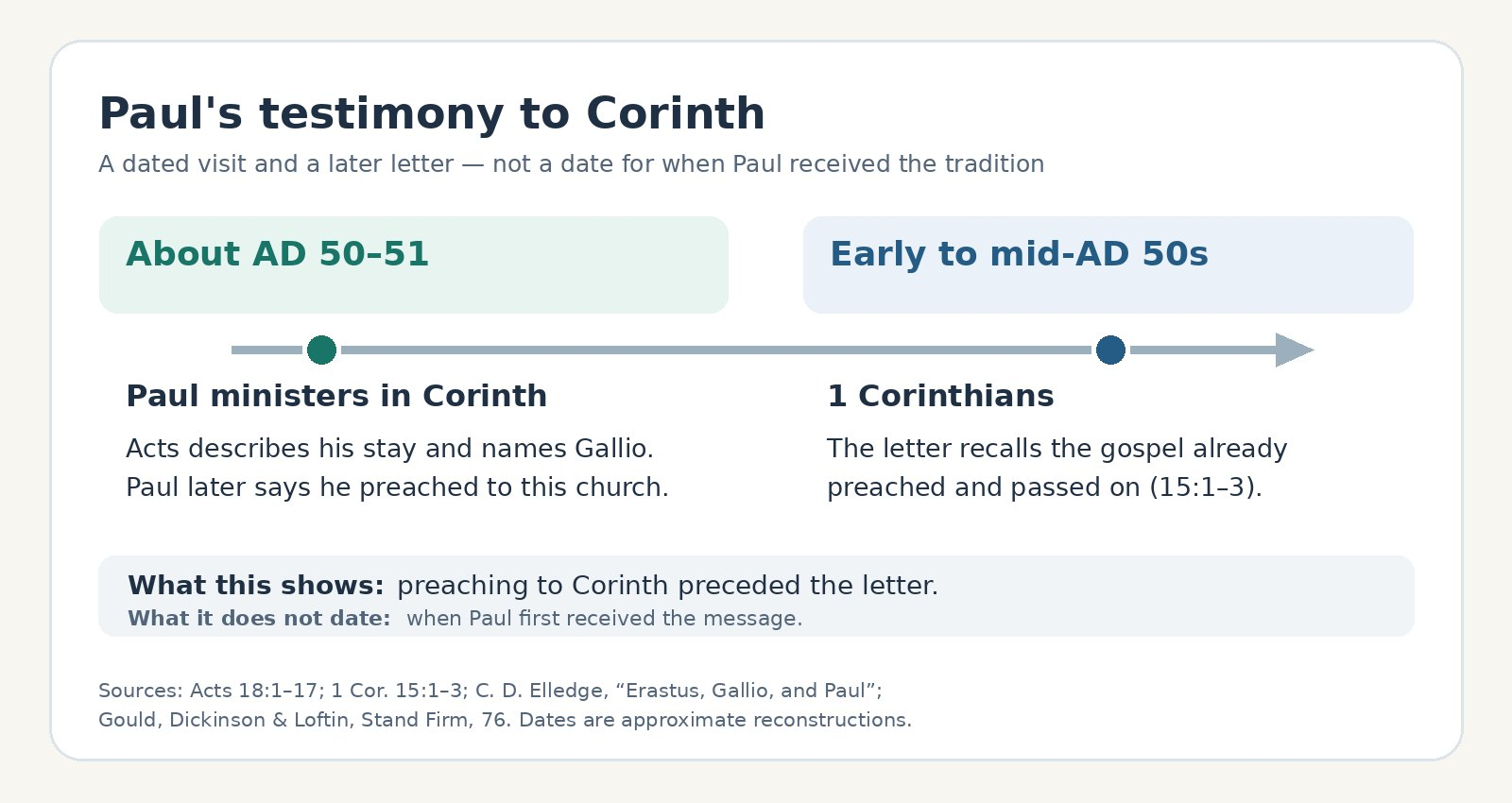
In the Book of Acts, Luke writes about Paul’s mission to Corinth. Paul ministered for a year and six months, preaching the Gospel to both Jews and Gentiles (Acts 18:1–11, ESV). While we are not told a date for Paul’s ministry, we are given some context clues that we can use to help identify a time period. During Paul’s visit Luke tells us that Gallio was the proconsul of Achaia and that the Jews there brought Paul to a tribunal (Acts 18:12, ESV). Why is this important?
In the article Erastus, Gallio, and Paul, C. D. Elledge tells us that there was a Greek inscription from Emperor Claudius to the people of Delphi. This inscription mentions “Lucius Junius Gallio”, which is the same Gallio in Acts that mediated between Paul and the Corinth Jews. This inscription is dated around 52 A.D. and supports an estimated time of Paul’s ministry in Corinth to be between 50 and 51 A.D.1
The authors of Stand Firm name 1 Thessalonians, Galatians, 1 and 2 Corinthians, Philippians, and Romans as the “undisputed epistles” they are discussing, and date those letters to the early to mid-50s A.D.2 In Reasonable Faith, William Lane Craig affirms this early timeline, noting that the tradition Paul quotes in 1 Corinthians 15 predates even his letters and was likely received no later than his visit to Jerusalem, if not earlier in Damascus.3 We see that in 1 Corinthians, Paul states that he had preached the Gospel. This combines with the inscription that supports Gallio from Acts and the early date placement for 1 Corinthians gives us a support for testimony of Jesus earlier than the first Gospels.
Remaining Objection
We need to address that just because we can place this testimony as early does not mean that it is accurate. What Paul’s letter shows here is that the message about Jesus’ death, resurrection, and reported appearances were being preached before the later Gospel accounts were written. While this does not verify every appearance and detail in the Gospels, it does show us there was earlier testimony and points to people Paul claimed could serve as potential witnesses.
Conclusion
While early testimony alone does not automatically prove the historical reality of every claim, it establishes a vital chronological boundary. The timeline supported by 1 Corinthians, alongside external anchors like the Gallio Inscription, shows that the core message of Jesus’ death and resurrection was not a myth invented centuries later. Instead, it was an established proclamation documented within roughly two decades of the events, appealing to people Paul reported had seen Jesus while many of them were still alive.
Footnotes
-
C. D. Elledge, “Erastus, Gallio, and Paul”, Bible Odyssey, July 27, 2017. ↩
-
Paul Gould, Travis Dickinson, and Keith Loftin, Stand Firm: Apologetics and the Brilliance of the Gospel (Nashville, TN: B&H Academic, 2018), 76–77. The link is a book record, not free full text. ↩
-
William Lane Craig, Reasonable Faith: Christian Truth and Apologetics, 3rd ed. (Wheaton, IL: Crossway, 2008), chap. 8, “The Resurrection of Jesus,” under “The Fact of Jesus’ Empty Tomb.” The link is a book record, not free full text. ↩